The Last Shine:
Notes of a California Reporter - By Richard Alber, Sacramento Bee

In the 1920s and early 1930s, a young Sacramento Bee reporter tracked the hat shops and shoeshine stands that defined working-class style in California. This is his on-the-ground account of the ‘California Shine’—a craft that turned dust and sweat into dignity, from K Street in Sacramento to foggy San Francisco piers and Bakersfield rail yards. Today, as fast fashion and disposable shoes dominate, his notes are a reminder of what we lost when polish, patience, and neighborhood shops faded away.
The Sound That Shaped My Beat on California’s Shoeshine Stands
I can still hear it, the rhythmic “snap-snap-snap” of a horsehair brush striking leather. That sound carried through the air like a metronome of the working West. For half a century, it echoed from coast towns and dusty railroad stops, from San Francisco’s fog-choked piers to the orange groves beyond Riverside. I chased it for the “Bee”, notebook in hand, as a green reporter barely out of school, believing I was only chronicling a craft. In truth, I was watching a way of life polish itself into memory.
My First Assignment on K Street: Meeting California’s ‘Hat Men’
It began with what my editor called “a light piece on the hat men.” I found my first subject on K Street in Sacramento, in a narrow storefront perfumed with steam, cedar, and beeswax. The windows sweated from the kettle’s heat, and on the bench stood rows of wooden forms, ghosts of all the heads they had served.
The shopkeeper, a mustached Italian named Mr. DiMartino, nodded me closer. “Every man in California wears his fortune on his feet and his pride on his hat,” he said, then set to work on a sweat-stained fedora. He hovered it over a spitting kettle until the felt went limp as dough. “Steam,” he explained, “is the soul of the block.” With his thumbs, he stretched the crown onto a maple form, cinching it tight with a blocking cord. Then came the iron, a heavy piece called a “shackle”, pressed against the brim until the shape stiffened and took memory again.
When the job was done, he ran sandpaper lightly along the crown, erasing stray fibers in a technique he called “pouncing.” The hat emerged as smooth as river stone. Watching him, I realized this was more than trade, it was restoration, almost resurrection.
Across the Golden State: Tracking California’s Hat Shops and Shine Stands
That afternoon sent me on a decade-long journey to record these sanctuaries of polish and steam. In the years that followed, my notebook thickened with sketches, quotes, and the faint scent of naphtha that clung to my coat from every visit.
In San Francisco, I found specialists who carved their own poplar blocks and debated brim proportions with the seriousness of mathematicians. In Bakersfield, hatters worked through the night shaping wide western brims for ranch hands facing dry heat and whipping dust. Every shop used the same elements, water, heat, and patience, yet each carried its own flavor, its own cadence.
My folding camera captured neat rows of hat forms: stovepipes of the 1880s, bowlers from the 1890s, rakish trilbys and fedoras just coming into vogue. Together, they told a visual history of ambition, the West’s growing desire to look civilized while still wild at the edges.
Shoeshine Stands: Where the Public Sat in Glory
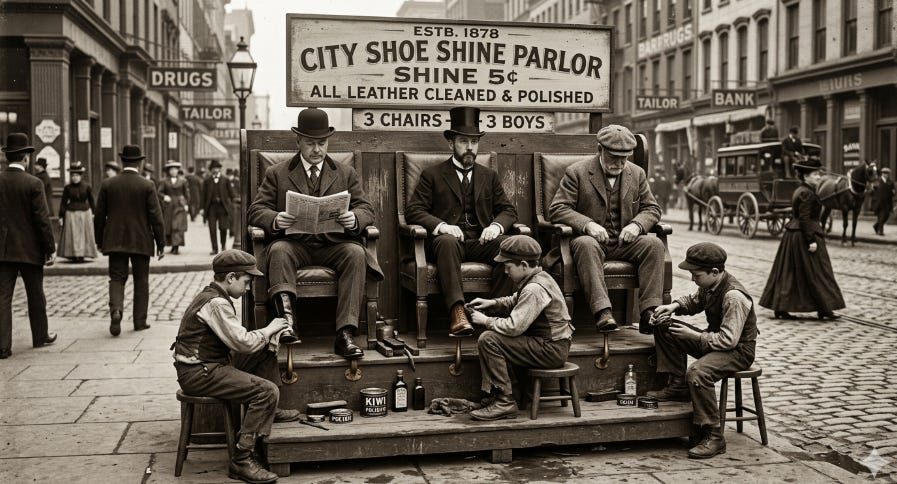
If the hat bench was the altar, then the shoeshine stand was the throne. I wrote more columns from those raised chairs than from any newsroom desk. They were fixtures of California life, mahogany platforms crowned with three high seats, brass footrests polished bright as coin.
In Los Angeles, one summer afternoon, I saw a railroad engineer climb into the center chair, boots caked with desert dust. “Tehachapi tomorrow,” he muttered, thumbing through a “Bee” the porter had left behind. Below him, the shiner moved with musical rhythm: rag, brush, paste, and then that familiar “snap-snap-snap”. By the end, the man’s reflection gleamed on the black leather toe, and something younger stirred in his face, as though the road he traveled had grown shorter.
By the twenties, this meticulous finish had a proud name: “the California Shine”. It demanded paste thick with oil and a soft flannel cloth buffed until the boot became a mirror. Barbers claimed to give confidence; these men proved it.
The People Behind the Brushes: California’s Shoeshiners and Hatters
The deeper I journeyed, the clearer it became that California’s polishers mirrored its diversity. In Fresno, I met a widow who ran her late husband’s shoeshine parlor alone, her presence commanding respect from judges and workers alike. In Santa Rosa, a Black veteran named Otis Green preached scripture while shining ferry passengers’ shoes to a sparkle. He’d say, “Cleanliness is next to godliness,” then he laughed, “and what’s cleaner than a man walking proud?”
Their trade blurred class lines. A banker and a brakeman sat side by side, bound by scuffed boots and a few cents of polish. Idle talk over the hiss of steam turned strangers into temporary equals. The shoeshine stand, I realized, was California’s most democratic institution, open daily, admission two bits.
The Instrument and Its Music: Blocks, Brushes, and Steam
Each shop possessed a private orchestra of sounds: the hiss of a steamer, the clink of brass footrests, the whisper of sandpaper smoothing felt, the small groan of wooden drawers sliding open. I catalogued their tools, shackles, blocking cords, pouncers, as carefully as a naturalist names species, afraid the vocabulary itself might die.
Once, in Monterey, a gray-bearded hatter showed me his oldest block, carved in 1882. The wood had darkened with sweat and oil until it gleamed like walnut. “She’s older than you, and humbler,” he said, patting it. “These heads remember longer than men.” When I revisited him years later, business had thinned, but the blocks still lined the shelves like patient sentinels.
The Tide of Change: Cars, Fast Fashion, and the End of the California Shine
Progress crept into every corner of California life. Automobiles replaced wagons, and closed tops meant hats were less shield than symbol. Men now hurried behind glass and steel, no time to sit for a shine. Factories began advertising “five-minute polish” with chemical tins that mimicked the old paste’s sheen.
By the mid‑twenties, the younger crowd preferred mass‑made fashion from Los Angeles shops, not yesterday’s tailored felt. As one craftsman sighed to me, “Speed’s the new virtue, and steam’s too slow.” Still, many persisted. I found small shops surviving on the loyalty of men who valued care over convenience. Their lights burned late, flickering against an age racing to forget them.
Lessons from the Road on Craft, Class, and Respectability
I crisscrossed the state, filing stories, sometimes front‑page features, sometimes small human-interest pieces on page seven. My colleagues teased me for chasing “the shine beat,” but readers responded. They sent letters recalling the smell of polish on Market Street or the pride of their father’s Sunday hat freshly blocked. One old farmer from Bakersfield wrote, “You make them fellows sound like preachers.” Maybe they were.
Each time I returned to my office on Seventh Street, the newsroom noise felt harsher. Out there, in the glow of a workbench lamp, there was patience, civility, a rhythm older than the telegraph keys clattering beside me. So I kept at it long after editors lost interest.
A Vanishing Brotherhood
The crash came like a cold wind. The Depression stripped the polish first from the customers, then from the craft itself. When money tightened, men wore their shoes until they cracked and their hats until the crowns sagged beyond repair. When new work came, it was in factories, uniforms, not fedoras.
In late 1930, I visited Mr. DiMartino once more. His shop was dim; the kettle was cold. On the bench lay rows of wooden blocks gently wrapped for storage. He picked one up, a style from decades past, and smiled faintly. “Nobody wants these heads anymore,” he said. I helped him to crate the rest. Outside, the winter rain left the sidewalks shining naturally, as if mocking our labor.
What Time Could Not Erase
Looking back through my notebooks, I see those men and women as guardians of respectability. They held California together with polish and perseverance, teaching ordinary people to face the world looking their best, no matter how hard the work behind them. The gleam they created was confidence manifest, a promise that effort could turn rough beginnings into refinement.
Even now, when I walk past a shop window and catch my reflection on clean glass, I recall the hum of those little sanctuaries: the hiss of steam, the cedar smell, the sturdy humor of men who believed excellence was its own advertisement. Somewhere in their rhythm, “snap-snap-snap”, the old California still lives.
“