Rolling Change
Maria Beasley’s Impact on American Commerce

The air in Philadelphia during the spring of 1878 was heavy with smoke and sawdust. Horse hooves clattered on wet cobblestones, blacksmith hammers rang against anvils, and out near the Schuylkill River came the steady rasp of coopers shaping staves into barrels. The sound was rhythmic, almost like music, but to a thirty-one-year-old woman named Maria Beasley it sounded more like drudgery than song. She watched the sweat-soaked men bend and hammer until their wrists ached and thought to herself that the barrels they produced, though necessary, were costing too much in labor, too much in human wear, and too much time. If barrels were the lifeblood of commerce, why in the centennial age of America should they be shaped as they had been in the Middle Ages?
Maria, who signed her patents as Mrs. Maria E. Beasley of Philadelphia, was no trained machinist. She kept a neat, respectable home, had family ties that asked much of her, and lived within a society that preferred women to tend bread and needle rather than tool and blueprint. Yet she was restless in her curiosity. She read trade journals at the kitchen table by lamplight, with the smell of yeast and flour clinging to her apron, and she sketched out ideas while her children slept. Her mind seized on one recurring thought: barrels rolled across every dock, rattled along every wagon, stacked in cellars and warehouses. They carried beer from Philadelphia’s bustling breweries, grain from western mills, salted pork downriver to ports, kerosene for lamps, nails for construction. Commerce rode inside casks, yet still every stave was fitted by hand, every iron hoop hammered over wood with grueling repetition. She saw inefficiency where others saw tradition.
On the afternoon of May 3, 1878, Maria stood in line at the Philadelphia patent attorney’s office with her hands clutching a rolled set of drawings and specifications. Oil lamps hissed in the tall-ceilinged room. Clerks with ink-stained sleeves scribbled applications. A tall, impatient man ahead of her muttered, “I need my loom filed before the week ends.” Maria knew her presence was notable. Fewer than one percent of inventors who dared to enter these offices were women. Yet when her name was called, she walked forward with her chin lifted, her quiet voice steady. She declared her invention an improved machine for hooping barrels, designed, in her precise words, “to secure the barrel staves in place and tighten the hoop with greater expedition and perfect uniformity.”
“Do you understand what you are taking on?” the clerk asked kindly but with a hint of patronizing surprise. “Coopers are not fond of giving up their trades.”
Maria looked directly at him and replied, “I understand very well. I am not here to take work away. I am here to make a tool that delivers what our growing commerce demands. The world is moving faster. Machinery is moving faster. Barrels ought to keep pace.”
The man chuckled softly, but he stamped her filing with official ink. The thick smell of it clung to her papers as she carried them home, her pulse racing.
Weeks later, when the patent was granted, Maria adjusted her bonnet and coat and carried the news to her husband that evening. He was skeptical, asking what profit could ever come from such a contraption built by a woman who had never swung a cooper’s hammer. Maria answered evenly, “Profit will come in time, but I do not measure my worth in coppers or dollars first. I measure it in proving that invention belongs to whoever imagines it, not to whoever tradition approves.”
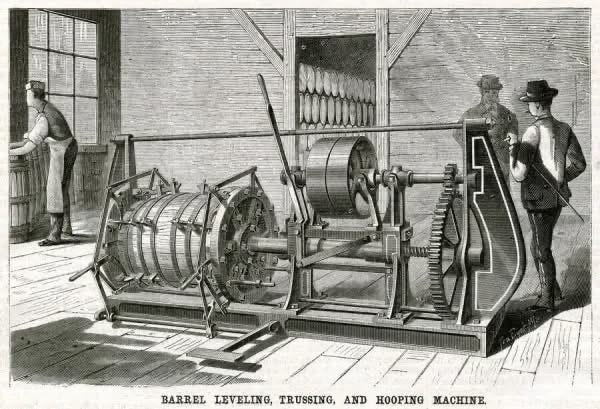
By autumn, a prototype of her barrel-hooping machine stood in a workshop on Callowhill Street. The space smelled of oak shavings and coal smoke, and the machine gleamed with freshly oiled gears. It consisted of a circular frame that could embrace a cluster of wooden staves, clamps to hold them upright, and a mechanism to draw down the iron hoop and fasten it tight. The workers gathered hesitantly, crossing their broad arms and raising their brows. One seasoned cooper muttered, “Been bending staves since Lincoln was president, never saw a lady tell iron what to do.”
Maria nodded at the younger man cranking the handle. The gears turned with a satisfying metallic chatter. The clamps closed in, holding the barrel’s skeleton firm. The hoop slid neatly over the clicking staves and locked them tight. No hammer, no buckling staves, no wasted time. In mere moments, the form stood secure, ready for heading.
The silence was abrupt. One workman spat into the sawdust and said grudgingly, “Well, she does the job.” Another added more softly, “Faster than our mallets would.”
Maria breathed deeply, the smell of pine resin and iron in her lungs, and thought, perhaps, she belonged here after all.
Within months, word spread. Philadelphia’s brewers, ever eager to ship beer by the keg to Chicago, Baltimore, and New York, recognized the profit of shaving time off barrel production. Several firms paid for the rights to her design. By 1879, Maria had secured contracts and fees that supported her family. When she walked through the muddy market streets, dress hem brushing damp wood slats and the salty tang of pickled fish barrels in the air, she could glance toward warehouses and know some of those rolling casks had been assembled with her invention.
When friends questioned if she would stop there, she answered briskly: “An idea once proved only calls for another. The mind does not sleep after its first triumph. It wakes.”
But while buyers welcomed her, coopers’ guilds spoke with suspicion. “Machines cannot judge the slip of a stave,” one foreman declared at a tavern meeting, the smell of sour ale mingling with pipe smoke. “You cannot trust gears with the fit that a hand knows.”
Maria overheard such remarks when she visited workshops to promote her device. She would not argue loudly. Instead, she would state simply, “We do not curse the loom for weaving cloth more quickly, nor the press for setting type. Progress waits for no man, nor for any woman.” Her eyes would flash with quiet determination, and though some scoffed, others found themselves swayed.
By the early 1880s her machine had crossed beyond Philadelphia, reaching cooperages in other cities. Reports noted the advent of “lady-made machinery” at industrial fairs, though journalists often seemed more interested in her gender than in the mechanics. One column in the Philadelphia Inquirer remarked, “It is curious that a housewife has busied herself with the hoops of barrels.” Maria cut the clipping and laid it in her desk, frowning at the word “curious” but pleased nevertheless that her work had entered print.
On a crisp November evening of 1882, as twilight fell and the last orange glow reflected in puddles near Broad Street, Maria sat with her sister by the fire. The flames flickered, warmth mingling with the faint smell of coal gas from the street lanterns outside. Her sister asked, “Do you not tire of fighting men who care more for pride than improvement?”
Maria stirred her tea and answered, “Perhaps they will not listen today. Perhaps not tomorrow. But barrels must be made, and profit will rule the day. If my machine delivers profit, it will survive. And if it survives, then my name will prove a woman may inscribe herself among inventors, no less than any man.” She sipped slowly, the taste of strong black tea grounding her thoughts.
Time proved her correct. By the end of the decade, mechanized hooping and heading were spreading through the cooperage industry. While not every detail of her patent was used exactly, her innovation marked a turning point, one of the early steps toward the full mechanization of barrel production. And Maria, through licensing and fees, gained both credibility and resources to pursue further inventions.
She had beaten back doubt, overcome the disbelief of clerks and coopers, and placed her name in the Patent Office records at a time when women inventors were almost unknown. The success of her barrel machine fueled her confidence when she later dared to design a derailment-prevention system for trains, a bread-kneading machine for kitchens, and most famously, a collapsible life raft that would someday stand between hundreds of souls and the sea.
Maria lived to see many of her ideas tested, resisted, and adopted at different scales. Yet the barrel machine was always her beginning. Without its success, her career as an inventor might have ended in discouragement and dismissal. She proved not only that barrels could be hooped by machine but that a woman could stand inside the forge and workshop of industrial America without apology.
Years after her death, when mechanized cooperage was taken for granted, barrels rolled silently in warehouses without anyone asking who had first sought to spare a man fifty hammer strikes by clever gearwork. Yet if one bent close to the patent books, the ink still bore her name, legible and enduring.
The lesson of Maria Beasley’s barrel machine is not merely one of invention but of courage. She heard the monotonous ring of hammers, smelled the sweat of tired men, and felt compassion mixed with practicality. Where others shrugged and carried on, she asked, “What if there is a better way?” And because of that question, hundreds of thousands of barrels could be made faster and more uniformly than before.
Her story reminds us that innovation often begins not in opulent laboratories but in modest kitchens and small workshops, born from the mind of someone who notices what others take for granted. Maria Beasley noticed, she acted, and in doing so she rolled her own claim to immortality into the grooves of commerce. The barrels that carried beer, nails, and salted pork also carried within them the memory of a woman who believed work could be lighter, faster, and fairer, and who taught the world that invention has no gender but only grit.